Key Takeaways
- Protect yourself and others before approaching an emergency scene.
- Call 911 early, use speakerphone, and follow dispatcher instructions.
- CPR, AED use, choking response, and bleeding control can make a critical difference before responders arrive.
- Stroke, heart attack, severe allergic reactions, seizures, and breathing problems need prompt attention.
- Simple planning and hands-on practice help people act more calmly under pressure.
Medical emergencies can happen at home, at work, at school, in a store, or on the road. Knowing a few basic steps does not replace professional care, but it can help you respond with purpose while emergency crews are on the way. Building confidence through online CPR and First Aid certification can help households, caregivers, and workplace teams prepare before a crisis occurs.
The first priority is not advanced treatment. It is staying safe, recognizing that something is wrong, calling 911, and giving only the care you can provide safely. A calm bystander who communicates clearly and follows directions can be an important link between the emergency and professional medical help.
Start With Scene Safety and a Quick Assessment
Before moving toward someone who has collapsed or been injured, look for hazards such as traffic, fire, smoke, exposed electrical wires, broken glass, violence, unstable structures, or chemical spills. Keep children and unnecessary bystanders away. If gloves or a breathing barrier are available, use them, but do not delay an urgent 911 call to search for supplies.
Once the area is safe, check whether the person responds to a calm voice and a gentle tap. Look for normal breathing, severe bleeding, obvious injuries, skin-color changes, trouble speaking, or unusual movement. Gasping is not normal breathing. If the person is awake, ask simple questions, such as their name and what happened, while you wait for help.
Call 911 Early and Organize the People Nearby
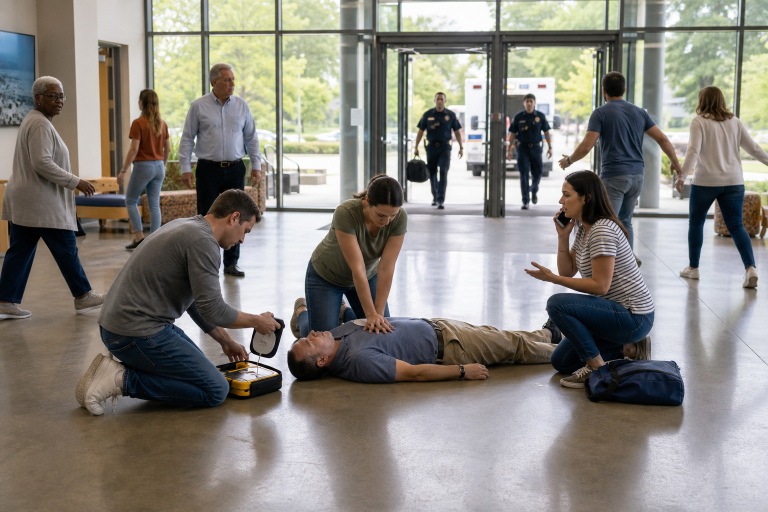
Call 911 as soon as a situation appears life-threatening or uncertain. Put the phone on speaker so your hands remain free and the dispatcher can guide you. Give an exact location, including an apartment number, floor, entrance, landmark, or nearby cross street. Describe what happened, whether the person is conscious and breathing, and any major bleeding or symptoms you see.
If other people are present, assign clear jobs. Tell one specific person to call 911, another to locate an AED or first aid kit, and another to meet responders at the entrance. Avoid vague requests such as “someone call for help,” because people may assume somebody else has already acted.
When a Person Is Unresponsive and Not Breathing Normally
For an unresponsive adult or teen who is not breathing normally or is only gasping, call 911 and begin CPR as directed. Hands-only CPR is an appropriate option for many bystanders responding to a sudden adult or teen collapse. Place the heel of one hand in the center of the chest, place the other hand on top, and push hard and fast at a steady rate of about 100 to 120 compressions per minute.
Continue until the person starts breathing or moving, trained responders take over, or the scene becomes unsafe. If you are trained and willing to provide rescue breaths, follow your training and dispatcher guidance. CPR guidance differs for infants, children, drowning, choking, and other circumstances, which is one reason practice matters.
Use an AED as Soon as One Arrives
An automated external defibrillator, or AED, is designed to guide users with voice and visual prompts. Turn it on, expose the chest, place the pads exactly as shown, and follow the device instructions. Keep everyone clear while it analyzes the heart rhythm and whenever it advises a shock. Resume CPR immediately when the AED directs you to do so. The basic steps for cardiac arrest response emphasize calling 911, starting CPR, and using an AED without unnecessary delay.
Responding to Choking and Severe Bleeding
A person who can cough forcefully or speak may have a partial airway blockage. Encourage them to keep coughing and watch closely. A person who cannot speak, breathe, or cough effectively needs immediate help. Call 911 and provide choking care according to your training, which commonly involves cycles of back blows and abdominal thrusts for conscious adults and children. Infants and pregnant people require modified techniques.
If a choking person becomes unresponsive, lower them carefully to the ground, call 911 if that has not happened, and begin CPR. Do not perform blind finger sweeps. Only remove an object from the mouth if you can clearly see it.
Life-threatening bleeding may be heavy, continuous, spurting, or rapidly soaking clothing or dressings. Apply firm, direct pressure with gauze, a clean cloth, or available material. Add more material over a soaked dressing instead of repeatedly removing it. If you are trained to use a tourniquet, or a dispatcher directs you to do so, apply it according to those instructions. Keep monitoring the person for changes in alertness or breathing.
Recognize Stroke, Heart Attack, and Other Urgent Conditions
Stroke symptoms can include sudden facial drooping, arm weakness, speech trouble, confusion, balance problems, vision changes, or a severe, unexplained headache. The signs of a possible strokerequire a 911 call right away, even if symptoms improve after a few minutes. Note when the person was last known to be well, because that information can help the medical team.
Possible heart attack symptoms include chest pressure or discomfort, shortness of breath, sweating, nausea, lightheadedness, or pain spreading to the arm, back, jaw, or other areas. Symptoms can vary, particularly among women, older adults, and people with diabetes. Call 911 rather than waiting or driving the person yourself.
For a seizure, move dangerous objects away, cushion the head if possible, do not restrain the person, and do not place anything in their mouth. Track how long it lasts. For a severe allergic reaction, call 911 and help the person use their prescribed epinephrine auto-injector if they have one. For burns, move away from the heat source and cool the area with clean running water when appropriate. For suspected poisoning, do not guess at treatment or induce vomiting unless directed by medical professionals.
What Not to Do
- Do not enter a dangerous scene or become another injured person.
- Do not delay calling 911 while searching for the perfect answer.
- Do not give food, drink, or medication unless it is appropriate and emergency guidance supports it.
- Do not move someone with a possible head, neck, or back injury unless immediate danger makes movement necessary.
- Do not crowd the person or allow multiple people to give conflicting directions.
Prepare Before an Emergency Happens
Keep first aid supplies accessible, know the location of nearby AEDs, and post the full address of your home or workplace where people can see it. Families, schools, and employers can assign simple roles for calling 911, retrieving equipment, guiding responders, and caring for others nearby. Review the plan after a move, staffing change, or new medical need.
Reading emergency instructions is useful, but hands-on practice makes key actions easier to recall during stress. Regular refreshers can help people recognize their limits, use equipment correctly, and work as a team. When every minute matters, the goal is simple: stay safe, call for help, and provide basic care until professional responders arrive.